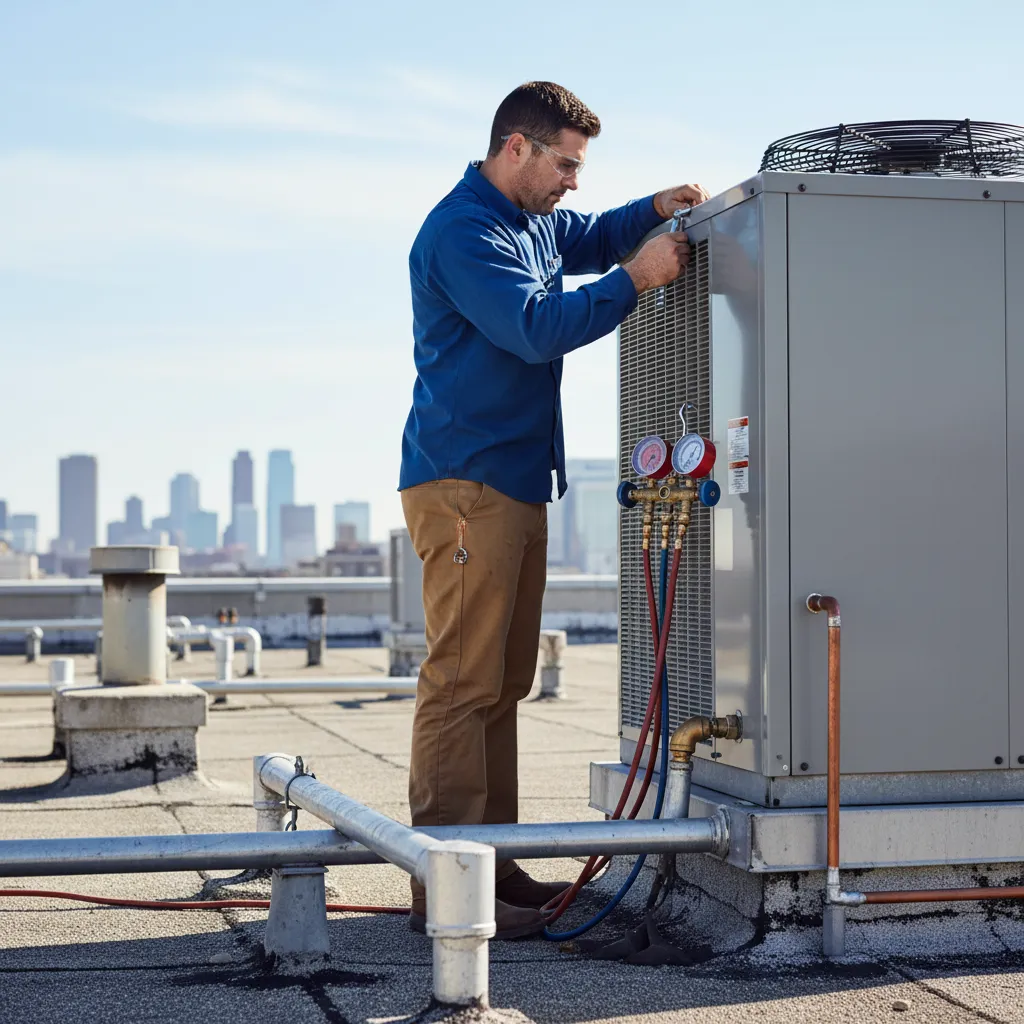








Key Takeaways
General liability alone starts at $75/month in Texas, but most HVAC businesses need a full package with workers comp, commercial auto, tools coverage, and sometimes pollution or professional liability. The total depends on payroll, vehicles, work type, and contract requirements.
- General liability starts at $75/month (Texas minimum premium, NEXT Insurance). Full package costs go up with employees, vehicles, and commercial contracts.
- Standard general liability policies often exclude refrigerant releases and mold claims. Ask about contractors pollution liability when you get quotes.
- Some commercial GCs require $5M limits, additional insured endorsements, waiver of subrogation, and completed operations coverage on the certificate.
- Payroll size, vehicle count, work type, limits, and claims history all affect what carriers charge for the policy.
Coverages HVAC contractors carry — and why you probably need more than GL
Most HVAC businesses need more than a general liability policy. GL covers third-party bodily injury and property damage claims at the job site and after the work is done. But it does not cover your employees, your vehicles, your tools, or the pollution and design exposures that are common in HVAC work.
A typical HVAC insurance package includes five or six coverage lines. Which ones you need depends on whether you have employees, own service vehicles, handle refrigerants, do design work, or sign commercial contracts.
Answer a few questions about your business to see which coverages you should quote.
HVAC Coverage Needs Assessment
Answer HVAC risk questions and get a focused coverage list to quote.
Step 1
Do you have HVAC employees or helpers?
Tell us about your trade and coverage needs. We'll look for relevant options across our marketplace.
Free. No obligation. Takes 2 minutes.
400+ carriers carrier and market options overall · Licensed in 30 states · No fees to compare
General liability
GL responds to claims from customers, property owners, and bystanders alleging bodily injury or property damage caused by your work. Common HVAC examples: a technician damages a customer's ceiling during a duct installation, a visitor trips over equipment at the job site, or a completed installation allegedly causes water damage months later.
Standard limits are $1,000,000 per occurrence and $2,000,000 general aggregate. That means two large claims can exhaust the policy for the year. Commercial contracts often require higher limits.
Workers compensation
Workers comp covers medical costs and lost wages when an employee is injured on the job. HVAC work involves ladders, rooftop units, electrical exposure, and heavy equipment. BLS data for plumbing, heating, and air-conditioning contractors shows total recordable injury rates between 2.7 and 3.4 per 100 full-time workers from 2020 through 2024.
Premiums are calculated per $100 of payroll under the class code assigned to your work. More employees and higher payroll mean a higher premium. Your experience modification rate (EMR) adjusts the premium based on your claims history compared to similar businesses.
Commercial auto
If your business owns vans or trucks, you need a commercial auto policy. It covers liability and physical damage for company-owned vehicles. If technicians use personal vehicles for service calls, a hired and non-owned auto (HNOA) endorsement covers the business when employees drive their own cars for work.
Vehicle accidents represent a major portion of contractor losses. Carriers ask about vehicle count, driver records, travel radius, and whether you have a written fleet safety program.
Tools and equipment (inland marine)
HVAC contractors move expensive diagnostic tools, recovery machines, gauges, pumps, and portable equipment between job sites. A standard property policy may not cover tools once they leave your shop. Inland marine or tools coverage protects this equipment in transit and at the job site.
Package or BOP for smaller operations
A business owners policy (BOP) bundles GL with property coverage and sometimes business interruption. Smaller HVAC operations with a shop, limited payroll, and straightforward residential work may qualify. Larger commercial accounts or firms needing specialized endorsements typically need a standalone program.
What HVAC contractor insurance costs — and what the starts-at number actually covers
NEXT Insurance lists HVAC contractor general liability starting at $75 per month, based on a minimum premium for HVAC businesses in Texas. A full package with workers comp, commercial auto, and tools coverage costs significantly more.
That number covers GL only. It does not include workers compensation, commercial auto, tools coverage, pollution liability, or umbrella. For most HVAC businesses with employees and vehicles, the total annual program cost is significantly higher.
Factors that push the total package cost higher: employees (adds workers comp), service vehicles (adds commercial auto), owned tools and equipment (adds inland marine), commercial contracts requiring $5M limits (adds umbrella or excess), refrigerant handling (may add pollution liability), and design services (may add professional liability).
Tell us about your trade and coverage needs. We'll look for relevant options across our marketplace.
Free. No obligation. Takes 2 minutes.
400+ carriers carrier and market options overall · Licensed in 30 states · No fees to compare
How carriers price an HVAC insurance account
Carriers ask about specific business details when quoting an HVAC account. Each detail can raise or lower your premium. Understanding what they ask helps you anticipate the quote process and compare returned options.
Work mix
Residential service and replacement, light commercial installation, industrial refrigeration, cannabis or manufacturing ventilation, and design-build projects are not the same risk. A residential service contractor with $300K revenue is a different account than a commercial mechanical contractor signing $5M-limit subcontracts. Carriers classify these differently and price accordingly.
Payroll and employee count
Workers comp premiums scale directly with payroll. More employees and higher wages mean a higher premium. GL may also use payroll or receipts as a rating basis depending on the carrier and class code.
Vehicles and driving records
Carriers ask about vehicle count, vehicle type, driver ages, MVR records, and travel radius. Vehicle accidents represent a major portion of contractor losses, so annual driving-record screenings and hands-free cell-phone policies can help control that exposure.
Prior loss history and EMR
Your claims history over the past 3-5 years directly affects pricing. A high experience modification rate (EMR) raises workers comp premiums. Frequent GL or auto claims signal higher risk to underwriters. Clean loss history is one of the strongest factors in getting competitive quotes.
Safety programs
Risk-management tools such as on-site risk assessments, written safety programs, regular training, and claims support can improve your account profile. Some carriers offer premium credits or broader coverage terms for contractors with documented safety programs.
Contract burden and required limits
A small residential repair business with $1M/$2M limits is a different account than a subcontractor signing commercial GC requirements. One commercial GC requirement document lists HVAC among trades requiring $5,000,000 each occurrence, $5,000,000 products-completed operations aggregate, and $5,000,000 general aggregate, satisfied through general liability plus excess liability.
| Rating Factor | What Carriers Ask | Effect on Premium |
|---|---|---|
| Work mix | Residential service, commercial install, industrial, design-build | Commercial and industrial work priced higher than residential service |
| Payroll | Total payroll, employee count, class code split | WC scales directly with payroll amount |
| Vehicles | Count, type, driver records, radius | More vehicles and poor MVRs raise auto premium |
| Loss history | 3-5 year claims, EMR | Clean history lowers premium; frequent claims raise it |
| Safety programs | Written program, training records, fleet controls | May qualify for credits or broader terms |
| Contract limits | Required limits, AI endorsements, umbrella need | Higher required limits add umbrella/excess cost |
The marketplace compares your account with carriers from 400+ options that insure HVAC work. Licensed support is available in 30 states for complex accounts or tight deadlines.
Gaps standard GL leaves open: refrigerant, mold, and design-build exposure
Standard general liability policies often contain pollution exclusions. For HVAC contractors, that exclusion can apply to refrigerant releases, mold growth from failed systems, and cleanup costs. These are not rare exposures for this trade.
Refrigerant releases and mold
Refrigerant leaks can cause property damage and bodily injury claims. Mold growth from HVAC failures — failed dehumidification, condensation in ductwork, or improper drainage — can trigger expensive remediation and health claims. Standard general liability may classify these as pollution events and exclude them.
Contractors pollution liability (CPL) covers third-party bodily injury, property damage, cleanup costs, and legal defense for pollution events that general liability excludes.
If your work involves refrigerant handling, mold-sensitive environments like hospitals or schools, older buildings with potential asbestos or lead, or large commercial systems, ask about contractors pollution liability when quoting.
Professional liability for design-build work
GL covers bodily injury and property damage. It does not cover claims alleging errors in system design, load calculations, equipment specifications, or consulting advice. If your HVAC business designs systems or provides engineering services, professional liability (contractors E&O) covers those allegations.
Carriers may review HVAC design, engineering, sales consulting, and contractor services separately from installation labor.
How to check whether your GL excludes these exposures
- Look for the absolute pollution exclusion in your GL policy. If it exists, refrigerant and mold claims may be excluded.
- Ask your carrier whether a pollution buyback endorsement is available, or whether you need a standalone CPL policy.
- If you do any design, load calculation, or equipment specification work, ask whether your GL covers professional services or whether you need a separate E&O policy.
- Review your contract requirements. Some GCs require pollution liability or professional liability as a condition of the subcontract.
Tell us about your trade and coverage needs. We'll look for relevant options across our marketplace.
Free. No obligation. Takes 2 minutes.
400+ carriers carrier and market options overall · Licensed in 30 states · No fees to compare
What GCs and clients require on your certificate — and what the endorsement wording means
Commercial contracts specify what your insurance must include before you can start work. The certificate of insurance (COI) is evidence that your policy meets those requirements. But the certificate alone does not create coverage. The policy endorsements behind it must match what the contract asks for.
Baseline limits vs higher limits for HVAC
A standard commercial subcontract often requires $1,000,000 each occurrence, $1,000,000 personal and advertising injury, $2,000,000 products-completed operations aggregate, and $2,000,000 general aggregate.
HVAC is listed among trades that some GCs require to carry $5,000,000 limits — each occurrence, personal and advertising injury, products-completed operations aggregate, and general aggregate. This is typically satisfied through GL plus an umbrella or excess liability policy.
Additional insured endorsements
An additional insured endorsement extends your GL coverage to the party named on the endorsement for claims arising from your work. GCs require this so they have coverage under your policy if a claim from your operations names them.
The form edition matters. Older forms using "arising out of" wording were broader; later ISO forms using "caused, in whole or in part, by" narrowed the scope, and the 2013 and 2019 editions added contract-linked limitations.
Ongoing operations (CG 20 10) and completed operations (CG 20 37) are separate endorsements. An ongoing-operations-only endorsement may leave the additional insured unprotected for claims arising after the job is finished.
Waiver of subrogation
A waiver of subrogation prevents your carrier from recovering claim payments from the party named in the waiver. GCs require this separately from additional insured status because additional insured protection does not always prevent subrogation in every situation.
Completed operations on the certificate
HVAC failures can appear months or years after installation. A GC who requires completed operations additional insured status wants protection for claims that arise after your work is done. If your policy only provides ongoing operations additional insured coverage, the certificate may be rejected.
Select your contract type and required limits below to see which endorsements your policy needs.
HVAC Contractor Endorsement Checker
Check common HVAC GC endorsement requests before sending a COI.
Matching rows
Choose lookup inputs
Select one or more fields to filter the requirements table.
Verifying subcontractor insurance
If you hire subcontractors, you face the same requirements in reverse. Verify that your subs carry adequate insurance and provide certificates before allowing them on the job. Without written agreements and certificate tracking, a carrier may price more conservatively or decline certain projects.
Use this downloadable checklist to verify subcontractor insurance before allowing subs on your jobs.
HVAC Sub Insurance Checklist
Verify HVAC subcontractor coverage, endorsements, limits, and certificate dates before work starts.
1. Fill in details
0 of 8 fields filled
2. Review the preview
The document below updates as you type.
3. Download the file
Blank fields stay as fill-in lines.
Fill in details
Use only the details you have now. Empty fields remain editable in the downloaded checklist.
0/8 complete
Checklist
Download checklist
A downloadable checklist that organizes the insurance details for this task in one place.
Available as PDF, DOCX. The file uses the current field values.
Download
Preview of downloaded checklist
Updates as you type before download.
Preview of downloaded checklist
Updates as you type before download.
Next steps
- Compare the certificate and endorsements against the subcontract before work starts.
- Ask your agent to review wording when the contract requires specific AI or waiver forms.
- Set a renewal reminder for the earliest policy expiration date on the certificate.
- Keep the checklist, certificate, endorsements, and subcontract in the same project file.
How a ventilation claim pulled HVAC contractors into a wrongful-death lawsuit
Insurance Journal reported a wrongful-death lawsuit that shows how ventilation and mold allegations can pull mechanical contractors into costly litigation.
The allegations in this case involved ventilation design, system installation, mold, and airborne contaminants. These are exactly the exposures that standard general liability pollution exclusions may not cover.
For HVAC contractors doing commercial ventilation, industrial work, or design-build projects, this case illustrates why pollution liability, professional liability, and completed operations coverage are not academic add-ons. They respond to the kinds of allegations that actually get filed.
Tell us about your trade and coverage needs. We'll look for relevant options across our marketplace.
Free. No obligation. Takes 2 minutes.
400+ carriers carrier and market options overall · Licensed in 30 states · No fees to compare
Compare carriers that insure HVAC work like yours
The marketplace compares your account with carriers that insure HVAC work based on your work type, payroll, vehicles, state, and loss history. A residential service contractor with clean history and two vans is a different account than a commercial mechanical contractor with 20 employees and $5M limit requirements. Different carriers fit different accounts.
Submit one quick form. The marketplace compares your account with carriers that insure HVAC work for your work type, payroll, state, vehicles, and contract requirements. Licensed insurance professionals can review the options with you.
What happens after you submit
- Answer a few questions about your HVAC business: work type, employees, vehicles, revenue, state, and contract requirements.
- The marketplace compares your account with carrier options that insure this kind of work.
- Review returned options and coverage details. Licensed support is available by phone at (888) 698-7698 for complex accounts or tight deadlines.
Free. No obligation. No spam. Compare carriers that insure HVAC work like yours — get a smart match in minutes.
Frequently asked questions
What insurance does an HVAC contractor need?
Most HVAC businesses carry general liability, workers compensation, commercial auto, and tools/equipment coverage. Contractors who handle refrigerants, do design work, or sign commercial GC contracts often add pollution liability, professional liability, and umbrella coverage. The right package depends on your work type, employee count, vehicles, and what your contracts require.
How much does HVAC contractor insurance cost?
General liability for a small HVAC contractor in Texas starts at about $75 per month as a minimum premium. A full package with workers comp, auto, and tools costs more depending on payroll, vehicle count, work type, and state. Accounts with $5M limit requirements add umbrella or excess liability on top of that.
Does general liability cover refrigerant leaks or mold claims?
Usually not. Standard general liability policies have pollution exclusions that can apply to refrigerant releases, mold growth from failed HVAC systems, and cleanup costs. Contractors who handle refrigerants or work in mold-sensitive environments should ask about contractors pollution liability as a separate policy or endorsement.
What limits do commercial GCs require from HVAC subcontractors?
It depends on the GC and the project. Some commercial GCs require $5,000,000 each occurrence, $5,000,000 products-completed operations aggregate, and $5,000,000 general aggregate, satisfied through general liability plus excess liability. Residential and smaller commercial projects typically ask for $1M/$2M limits. The contract will spell out the exact numbers.
What is the difference between additional insured and waiver of subrogation?
Additional insured status extends your general liability coverage to the party named on the endorsement for claims arising from your work. Waiver of subrogation prevents your carrier from recovering claim payments from that same party. GCs often require both because additional insured status alone does not always prevent the carrier from pursuing subrogation.
Do HVAC contractors need professional liability insurance?
If your business designs systems, performs load calculations, specifies equipment, or provides consulting services, professional liability covers claims alleging errors in that design or advice. Installation-only contractors typically do not need it. Carriers classify HVAC design and engineering services separately from installation labor.